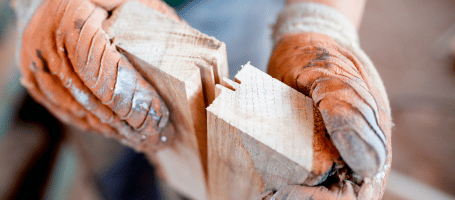
Boyes Turner’s mesothelioma and asbestos claims team have secured a settlement for the widow of a former carpenter/joiner with asbestosis even though no asbestos bodies were identified after the deceased’s death at post-mortem.
Exposure to asbestos
George instructed us after his diagnosis of asbestosis. He described the extensive and prolonged exposure to asbestos dust that he had experienced whilst working as a carpenter for a succession of companies, including:
- M J Gleeson Limited
- W E Chivers
- Taylor Woodrow
- Harbour (Civil Engineering) General Limited
- Sir Alfred McAlpine Construction
- George Wimpey & Company Limited
- Trade Promotion Services Limited
- W Salthouse (Blackpool) Limited
- Bovis Limited
- Clements & Street Limited
- J B Edwards & Company Limited.
During his employment George was exposed to asbestos dust and fibres whilst working in the vicinity of others who were mixing and applying asbestos lagging, cutting and fixing asbestos sheets, drilling into asbestos fire doors and fixing asbestos ceiling tiles. We instructed an engineer to report on the level of asbestos dust and fibres to which George would have been exposed during this work. The engineering expert assessed George’s asbestos dust exposure as over 100 fibre ml years, which is around four times the level that is usually seen when somebody has a diagnosis of asbestosis.
What is asbestosis?
Asbestosis is pulmonary fibrosis caused by extensive exposure to asbestos dust. In order to prove a claim for asbestosis we must prove that the claimant experienced moderate to heavy exposure to asbestos dust for many years. Where the claimant is still living, we prove the extent of their exposure to asbestos dust by serving a witness statement in which they describe for the court the circumstances of their asbestos exposure during their employment. When the injured person dies, further evidence of the extent of their asbestos exposure is obtained at post mortem by analysing their lung tissue to identify asbestos bodies. Where the deceased had pulmonary fibrosis caused by exposure to asbestos dust, we would expect to see extensive numbers of asbestos fibres and bodies within the lung tissue.
Asbestos claim
George had a number of other life-threatening co-morbidities and passed away soon after we were instructed. His wife, Barbara, took over his case. As is usual after an asbestos-related death, the coroner was notified and a post mortem examination was undertaken. At post mortem it was clear that George had evidence of asbestos calcified pleural plaques and areas of diffuse and extensive pulmonary fibrosis. However, on examination of George’s lung tissue, no asbestos bodies were identified in the lung samples. Despite these complications, we were pleased that we were able to negotiate a settlement of £50,000 for George’s family.
If you or a loved one have suffered from asebestosis or other asbestos-related diseases, contact us by email at [email protected].