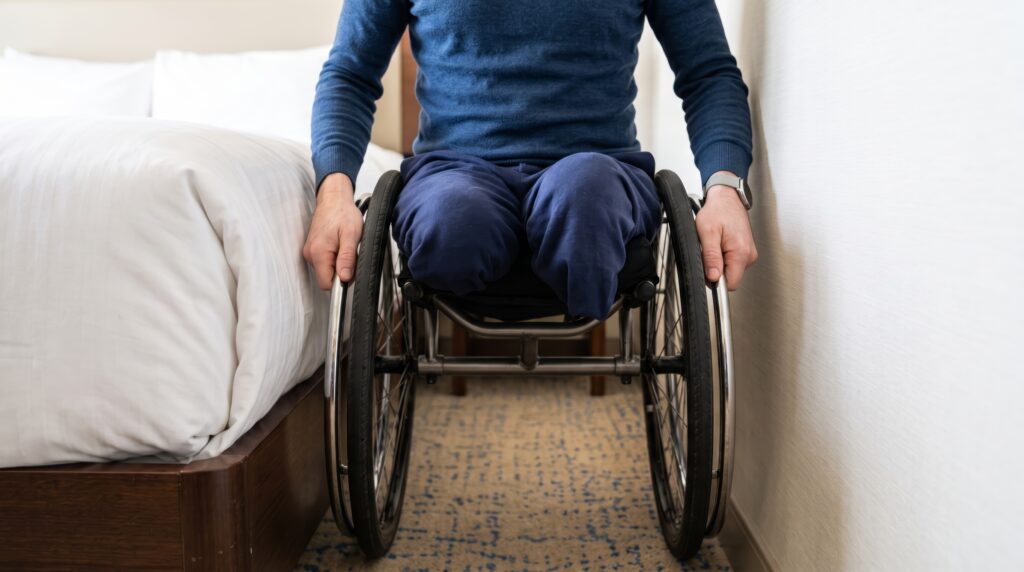
Boyes Turner’s amputation claims solicitors secured a £500,000 settlement for a 76-year-old man who suffered below-knee amputations to both his legs when a GP’s misdiagnosis and negligent referral letter led to delays in hospital treatment for his popliteal artery aneurysms and critical limb ischaemia.
GP failure to examine patient and take proper history leads to misdiagnosis
Our client attended his GP at the surgery with worsening pain in the back of his legs moving down from his calves to his ankles. The GP noted that he was a smoker. Without examining him or eliciting more information about the pain except that it was worse in the mornings, the GP diagnosed osteoarthritis and advised him to try over-the-counter supplements, given his inability to take non-steroidal anti-inflammatory drugs. If the GP had asked for more detail about the pain and taken a proper history, he would have learned that the pain was worse on exertion but was present even at rest, waking him at night and only easing when he swung his legs over the side of the bed.
Our client did not have pain in his joints and did not have osteoarthritis. He was suffering from symptoms of critical ischaemia, including the key symptom of pain at rest.
Two weeks later, our client mentioned his leg pain again to the GP who recommended a copper bracelet, cider vinegar and over the counter remedies, which he bought as well as painkiller medication which he applied to the back of his legs.
A further six weeks later, he had a telephone appointment with the GP, who noted the pain in his calves when walking and at night, described as a dull, deep ache with no swelling or redness. Without arranging a face-to-face appointment to examine our client or ask more about his pain, the GP diagnosed intermittent claudication. He advised that he needed an urgent doppler test, followed by a referral to the hospital vascular team. Our client did not have intermittent claudication but had signs of critical ischaemia which mandated an urgent referral to the hospital’s vascular surgeons.
GP’s referral letter fails to mention symptoms of critical limb ischaemia
The next day, the GP wrote a referral letter to the vascular surgery department at the hospital. The letter described our client’s complaint as intermittent claudication with limited ability to walk and severe pain moving down from his calves to his ankles which was only eased by rest. The letter asked whether he should be considered for vascular surgery and noted that the GP surgery could not perform a doppler test because their doppler machine wasn’t working. The letter failed to inform the vascular team about our client’s nighttime pain at rest, misdiagnosed intermittent claudication and failed to diagnose critical ischaemia. The referral was triaged by a consultant vascular surgeon who downgraded the referral’s urgency, based on the information provided by the GP. A routine appointment was offered for 14 weeks later.
Worsening symptoms and signs of critical limb ischaemia
In the meantime, two weeks later, our client had another call with the GP, who noted that he had intermittent claudication, severe calf pain after walking, and pins and needles at night in the soles of his feet. There was no redness, blackness, heat or tenderness in his feet. The GP noted the need to chase up the referral. Despite these reported symptoms of critical ischaemia, the GP did not arrange to see the claimant face-to-face, or to expedite the vascular surgeon’s appointment.
Nearly two weeks later, our client spoke to a different GP at the surgery who noted that he was in pain and unable to walk. Painkilling medication was helping but at night he was waking in agony with pain in his feet which were red and puffy. He had constant pins and needles and sunburn-like pain when bending his toes. He felt unable to continue with this pain until the hospital appointment. The GP advised him to increase his painkilling medication at night.
In another call with the defendant GP two weeks later he reported throbbing, swollen, red, painful skin on his toe and broken skin between his toes. The GP diagnosed cellulitis.
Critical limb ischaemia and popliteal artery aneurysm diagnosis too late to avoid amputations
Our client was so worried about his legs and feet that his wife sold her car to pay for a private appointment with the consultant vascular surgeon. The vascular surgeon examined him and found clear Buerger’s signs of critical limb ischaemia in both legs. A duplex scan revealed thrombosed popliteal arteries with trash thrombus down into the lower limbs. He diagnosed bilateral popliteal artery aneurysm occlusion and arranged for an urgent NHS CT angiogram.
Three days later, our client suffered a stroke. He was admitted to hospital and underwent CT angiogram of both legs which confirmed bilateral thrombosed popliteal artery aneurysms. He was unsuitable for all surgical and non-surgical (anti-coagulant) treatment options, owing to his advanced condition and his recent stroke. He developed necrosis in his feet and underwent below-knee amputations of both legs.
Successful GP negligence claim leads to £500,000 settlement
We helped our client make a GP negligence claim for compensation. The claim was based on the fact that the GP’s negligent failure to take a full history and examine our client, his misdiagnosis and negligent referral letter caused a delay in diagnosis and treatment of our client’s popliteal aneurysms and critical limb ischaemia, and below-knee amputations to both his legs.
The GP strongly denied any negligence and argued that during the pandemic our client wouldn’t have been seen by the vascular surgeons in time to avoid the loss of his lower legs. He maintained his defensive stance throughout the proceedings, obstructing any meaningful negotiation during a pre-action round table meeting (RTM) and his legal defence team at NHS Resolution denied multiple requests for an interim payment to pay for rehabilitation for our client and a trial of specialist prosthetics and physiotherapy to increase his mobility and independence.
Our client’s claim was supported by medical experts’ opinions, and by supportive factual statements from the hospital’s vascular surgeons confirming that urgent appointments for critical limb patients at the hospital were not affected by pandemic delays. After exchange of experts’ evidence, whilst preparing for trial, we met with NHS Resolution at a further RTM and secured a £500,000 settlement for our client.
If you have suffered severe injury as a result of medical negligence, or HSSIB/MNSI or NHS Resolution has contacted you, you can talk to a solicitor, free and confidentially, for advice about how to respond or make a claim by contacting us.
Written by

Julie Marsh
Julie is a partner within Boyes Turner’s outstanding medical negligence team. She specialises in high value and complex claims for clients whose lives have been changed by cauda equina (CES) and spinal cord injury (SCI), amputation, brain injury and disability caused by infections such as meningitis, sepsis and tuberculosis (TB).
Share this article:
Contact us
If you would like advice regarding a serious injury or illness affecting you or a loved one, please complete the form and one of our experts will be in touch as soon as possible.
Rather give us a call:
Related insights

Podcast
Video
What are interim payments?

Podcast
Video
Who is at risk of meningitis?

Podcast
Video
Medical negligence claims from errors in post-operative care

Podcast
Video
What is the personal injury discount rate (PIDR)?
Leading medical negligence solicitors for over 30 years






Stay informed with insights from Boyes Turner
Sign up to our newsletteres to receive helpful legal updates, real client stories, and practical guidance from our experts.