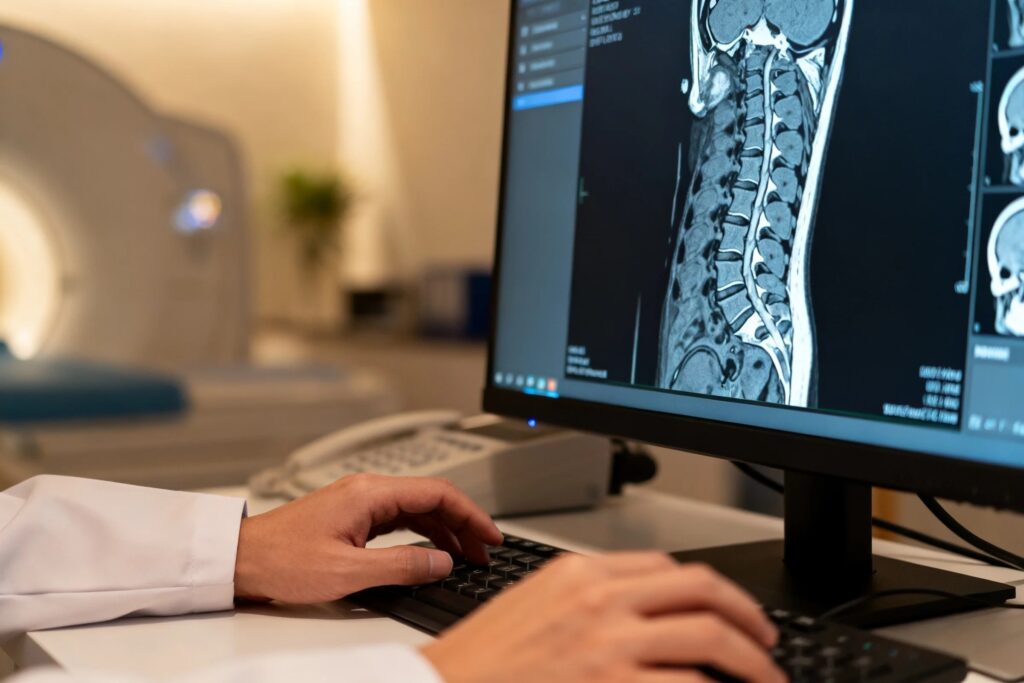
Boyes Turner’s cauda equina syndrome (CES) claims solicitors secured a £300,000 settlement for a woman in her forties who was left with CES disability, including urinary, bowel and sexual dysfunction, as a result of a hospital’s two-week delay in reporting an MRI scan. The negotiated settlement was achieved without the need for court proceedings.
Early stages of emerging cauda equina syndrome
Our client had a complex medical history with comorbidities which included back pain with episodes of sciatica, chronic fatigue syndrome and ME. She usually managed her back pain with painkillers and rest.
When she experienced a significant increase in her back pain with groin pain and numbness down her right leg and foot, she called NHS 111 and was advised to visit an out-of-hours GP for examination and treatment. She attended the out-of-hours centre the same day where a GP noted her severe and deteriorating pelvic pain on the right side with pins and needles in the right foot. The GP examined her, diagnosed sciatica and advised her to contact her usual GP for consideration of an MRI scan.
She saw her own GP two days later, who referred her for an MRI scan, noting that she had right iliac crest pain (at the top of the hip) radiating into the groin, suggestive of right-sided sciatica, with pins and needles in her right foot, but no bowel or bladder symptoms at that time.
Whilst waiting for the MRI scan, she continued to experience severe back pain with numbness and pain radiating down her right leg. Then three weeks later, she developed a new urinary symptom of significant urinary urgency. This was a red flag symptom for cauda equina syndrome.
Two-week delay in reporting MRI scan leads to delayed surgery and CES disability
Our client’s MRI scan took place at the hospital the next day. During the procedure she was asked whether she had experienced any urinary or bowel problems, and she told the radiographer about her recent urinary urgency. The radiographer noted that she was reporting bowel and bladder symptoms and discharged her with advice simply to see her GP if her symptoms worsened.
The MRI scan was not reported for another two weeks. If it had been correctly reported within 24 hours, it would have revealed that a bulging disc was causing severe stenosis (narrowing) of our client’s spine with cauda equina nerve root compression at L5/S1 (lumbar-sacral level) and she would have been referred for an urgent L5/S1 decompression and discectomy (disc removal) surgery within 24 hours of that report, avoiding the further deterioration and permanent disability which followed.
Progressive deterioration in CES signs and symptoms whilst waiting for MRI scan report
Whilst our client waited for her MRI to be reported, her symptoms become more severe. A week after the MRI scan, her back pain was so severe that she called her GP to ask whether the MRI scan results had been obtained. She was told that the results were still awaited and was prescribed codeine for her pain.
Four days later, she noticed reduced sensation in her ‘saddle area’ and then had an episode of faecal incontinence the next day. A further three days later she awoke early in the morning with severe back pain radiating into her leg. She called an ambulance and was taken to the hospital’s A&E.
On her arrival at hospital (more than two weeks after her MRI scan) the scan was finally reported, confirming her cauda equina nerve root compression. The next day, she underwent L5/S1 decompression and discectomy surgery at the hospital and was then sent home. Two days after her surgery she returned to the hospital with lower back pain. She was treated with painkillers and sent home again. She remained in severe pain and underwent a further revision decompression procedure three weeks after her original operation.
She was left with ongoing pain, bowel, bladder and sexual dysfunction and a psychological injury.
CES claim leads to settlement without court proceedings
Our client approached our specialist cauda equina claims solicitors and asked us to help her claim compensation for her CES disability. We obtained medical experts’ opinions and then sent a letter of claim to the defendant NHS trust on the basis that our client’s CES disability was caused by their negligent failure to report the MRI scan within 24 hours (given her worsening and new symptoms) and the resulting delay in performing spinal decompression surgery.
The defendant NHS trust admitted that our client had been in the early stages of CES on the day of the MRI scan and that they had been negligent in failing to report the MRI scan within 24 hours. They admitted that if the MRI scan had been reported correctly, our client would have undergone surgery within 48 hours of undergoing the scan. However, they denied that their negligence caused her CES disability, saying that earlier surgery would have made no difference to her outcome.
Instead of immediately issuing proceedings, our specialist cauda equina claims solicitors invited the NHS trust to consider early settlement via alternative dispute resolution (ADR). We made a settlement offer, supported by our schedule of our client’s loss, and the NHS trust responded with a request for some further information and a £300,000 settlement offer, which our client accepted. The NHS trust also offered our client a formal apology.
While I would ultimately recommend taking on a case—and I can’t praise my team enough—anyone considering it needs to know that the process is not for the faint-hearted. There were times throughout the journey where it felt so difficult that I genuinely regretted starting it, and moments where I was made to feel as though I was the one in the wrong. Those moments were never enough to put the brakes on. I felt very strongly about the importance of accountability and I had to continue. That is where Julie and her team made all the difference. Julie was nothing short of amazing. She managed to strike the perfect balance between genuine compassion and absolute professionalism and transparency. I was kept informed every single step of the way, and their turnaround for appointments, replies, and updates was incredibly fast. When the emotional strain got to me and my thoughts started spiralling, Julie always pulled me back, grounded me, and helped me process everything. If you have to navigate a tough legal battle, Julie and her team are exactly who you want in your corner. They are incredibly knowledgeable when it comes to the complex nature of cauda equina and how the aftermath impacts your life.
Our client
If you have suffered severe injury as a result of medical negligence, such as negligent GP or hospital delays in the diagnosis and treatment of cauda equina syndrome, or HSSIB/MNSI or NHS Resolution has contacted you, you can talk to a solicitor, free and confidentially, for advice about how to respond or make a claim by contacting us.
Written by

Julie Marsh
Julie is a partner within Boyes Turner’s outstanding medical negligence team. She specialises in high value and complex claims for clients whose lives have been changed by cauda equina (CES) and spinal cord injury (SCI), amputation, brain injury and disability caused by infections such as meningitis, sepsis and tuberculosis (TB).
Share this article:
Related case studies

Podcast
Video
£350,000 settlement after delays in surgery for red flag symptoms leaves woman with CES disability

Podcast
Video
£300,000 settlement in cauda equina CES claim for 78-year-old woman with pre-existing spinal stenosis

Podcast
Video
Hospital admits liability in CES claim after delayed MRI scan, diagnosis and treatment cause patient’s disability

Podcast
Video
£1.75 million settlement for cauda equina syndrome (CES) after negligent safety netting and treatment delays
Contact us
If you would like advice regarding a serious injury or illness affecting you or a loved one, please complete the form and one of our experts will be in touch as soon as possible.
Rather give us a call:
Leading medical negligence solicitors for over 30 years




Stay informed with insights from Boyes Turner
Sign up to our newsletteres to receive helpful legal updates, real client stories, and practical guidance from our experts.